
SEARCH THE
Anishinaabemowin and Kanien’kéha language-learning and cultural resources

The Bracebridge Library is excited to offer a growing collection of books to support your language-learning journey. We now have dictionaries for both Kanien’kéha and Anishinaabemowin, and an Anishinaabemowin thesaurus and phrase book.
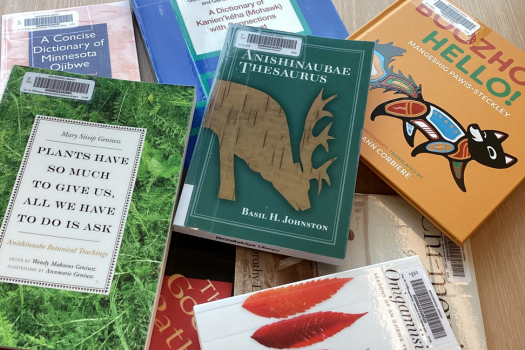
We also have a few other books that incorporate Anishinaabemowin or Kanien’kéha words, and some text with longer passages alongside English translations.
Check out some of our titles below!

Anishinaubae Thesaurus
Basil H. Johnston
The Anishinaubae (Chippewa/Ojibwe) language has beauty in the spoken word: deliberate rhythm, simplicity, and mysterious second meanings.
When Basil Johnston began teaching the Anishinaubae language in the late 1960s, there were no related manuals or dictionaries that were suitable for beginners. To fill this void, Johnston wrote a language course and a lexicon to serve as course materials.
Now he has broadened this labour by compiling Anishinaubae Thesaurus, which goes even further to fill a deep cultural and linguistic void. This thesaurus contains a useful sampling of the 400,000 words that comprise the Anishinaubae language, and it is intended to be a practical reference tool for teachers, translators, interpreters, and orthographers.
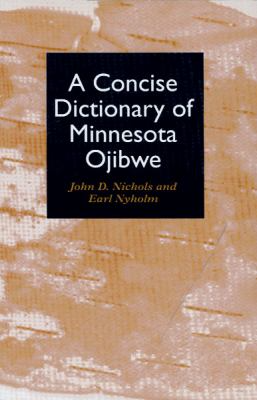
A Concise Dictionary of Minnesota Ojibwe
John Nichols
The most up-to-date resource for those interested in the linguistic and cultural heritage of the Anishinaabe, A Concise Dictionary of Minnesota Ojibwe contains more than 7,000 of the most frequently used Ojibwe words.
Presented in Ojibwe-English and English-Ojibwe sections, this dictionary spells words to reflect their actual pronunciation with a direct match between the letters used and the speech sounds of Ojibwe. It contains many ancient words and meanings as well as language added in the twentieth century.
Most entries give several sample inflected forms such as the plural, diminutive, and locative forms of nouns and first person and participle forms of verbs. The basic patterns of Ojibwe word structure and the organization of the dictionary entries are clearly explained in the introduction. The most widely used modern standard writing system for Ojibwe is used throughout, and some of the key objects of Ojibwe life are authentically illustrated by coauthor and artist Earl Nyholm.
Acknowledged as one of the three largest Native American languages, Ojibwe is spoken in many local varieties in the Upper Midwest and across Central and Eastern Canada. Minnesota Ojibwe is spoken in Central and Northern Minnesota, and is very similar to the Ojibwe spoken in the Ontario-Minnesota border region, Wisconsin, and Michigan’s Upper Peninsula.
A Concise Dictionary of Minnesota Ojibwe is an essential reference for all students of Ojibwe culture, history, language, and literature.

Pocket Anishinaabemowin (Ojibwe)
Patricia M. Ningewance
Pocket Ojibwe: a Phrasebook for Nearly All Occasions, by Patricia M. Ningewance, is a phrasebook organized in 12 sections for what to say in the Anishinaabe language: introduction; on arrival from the airport or bus depot; on the phone; visiting in the community; at a conference; at the school; the store or casino; at the hospital; the police; in court; in the social worker’s office; in the bush; at a ceremony.
Anishinaabe placenames and an English-Ojibwe glossary is included.

Plants Have So Much to Give Us, All We Have to Do Is Ask: Anishinaabe Botanical Teachings
Mary Siisip Geniusz
Mary Siisip Geniusz has spent more than thirty years working with, living with, and using the Anishinaabe teachings, recipes, and botanical information she shares in Plants Have So Much to Give Us, All We Have to Do Is Ask.
Geniusz gained much of the knowledge she writes about from her years as an oshkaabewis, a traditionally trained apprentice, and as a friend to the late Keewaydinoquay, an Anishinaabe medicine woman from the Leelanau Peninsula in Michigan and a scholar, teacher, and practitioner in the field of native ethnobotany. Keewaydinoquay published little in her lifetime, yet Geniusz has carried on her legacy by making this body of knowledge accessible to a broader audience.
Geniusz teaches the ways she was taught – through stories. Sharing the traditional stories she learned at Keewaydinoquay’s side as well as stories from other American Indian traditions and her own experiences, Geniusz brings the plants to life with narratives that explain their uses, meaning, and history. Stories such as “Naanabozho and the Squeaky-Voice Plant” place the plants in cultural context and illustrate the belief in plants as cognizant beings.
Covering a wide range of plants, from conifers to cattails to medicinal uses of yarrow, mullein, and dandelion, she explains how we can work with those beings to create food, simple medicines, and practical botanical tools.
Plants Have So Much to Give Us, All We Have to Do Is Ask makes this botanical information useful to native and nonnative healers and educators and places it in the context of the Anishinaabe culture that developed the knowledge and practice.

Onigamiising: Seasons of an Ojibwe Year
Lynda LeGarde Grover
Long before it came to be known as Duluth, the land at the western tip of Lake Superior was known to the Ojibwe as Onigamiising, “the place of the small portage.” There the Ojibwe lived in keeping with the seasons, moving among different camps for hunting and fishing, for cultivating and gathering, for harvesting wild rice and maple sugar.
In Onigamiising, Linda LeGarde Grover accompanies us through this cycle of the seasons, one year in a lifelong journey on the path to Mino Bimaadiziwin, the living of a good life. In fifty short essays, Grover reflects on the spiritual beliefs and everyday practices that carry the Ojibwe through the year and connect them to this northern land of rugged splendour.
As the four seasons unfold – from Ziigwan (Spring) through Niibin and Dagwaagin to the silent, snowy promise of Biboon – the award-winning author writes eloquently of the landscape and the weather, work and play, ceremony and tradition and family ways, from the homey moments shared over meals to the celebrations that mark life’s great events. Now a grandmother, a Nokomis, beginning the fourth season of her life, Grover draws on a wealth of stories and knowledge accumulated over the years to evoke the Ojibwe experience of Onigamiising, past and present, for all time.

Chi-mewinzha: Ojibwe Stories from Leech Lake
Dorothy Dora Whipple
In the first ninety-five years of her life, Dorothy Dora Whipple has seen a lot of history, and in this book that history, along with the endangered Ojibwe language, sees new life. A bilingual record of Dorothy’s stories, ranging from personal history to cultural teachings, Chi-mewinzha (long ago) presents this venerable elder’s words in the original Ojibwe, painstakingly transcribed, and in English translation to create an invaluable resource for learning this cherished language.

The Good Path: Ojibwe Learning and Activity Book for Kids
Thomas D. Peacock and Marlene Wisuri
Kids of all cultures journey through time with the Ojibwe people as their guide to the Good Path and its nine universal lessons of courage, cooperation, and honour.
Through traditional native tales, hear about Grandmother Moon, the mysterious Megis shell, and the souls of plants and animals. Through Ojibwe history, learn how trading posts, treaties, and warfare affected Native Americans. Through activities designed especially for kids, discover fun ways to follow the Good Path’s timeless wisdom every day.

Boozhoo! Hello!
Mangeshig Pawis-Steckley
Hello! Who do you see and hear in the woods today? Meet a variety of woodland and water animals in this story written in Anishinaabemowin and English.
Can you see a fox digging, spot two minnows dancing or hear a swarm of bees buzzing? Boozhoo! / Hello! introduces children to familiar animals as they go about their daily activities: walking, running, swimming, climbing and finally – when the day is done – sleeping!
Illustrated in a vibrant and colourful Woodland style that will appeal to readers young and old alike, and accompanied by an author’s note.

A Dictionary of Kanien’kéha (Mohawk) with Connections to the Past
Gunther Michelson
This dictionary provides a record of the Kanien’kéha (Mohawk) language as spoken by fluent first- and second-language speakers at the Kanien’kéha Mohawk Territory outside of Montréal, Canada.
The Kanien’kéha language has been written since the 1600s, and these dictionary entries include citations from published, archival, and informal writings from the seventeenth century onwards. These citations are a legacy of the substantial documents of missionary scholars and several informal vocabulary lists written by Kanien’kéha speakers, among others. The introduction to the dictionary provides a description of the organization and orthography of the historical works so that they can be used in the future by those studying and learning the language.
A Dictionary of Kanien’kéha (Mohawk) with Connections to the Past allows scholars and students to learn the meaning, composition, and etymology of words in a language known for its particularly complex word structure. The organization of the entries, according to noun and verb roots, highlights the remarkable potential and adaptability of the language to express traditional concepts, as well as innovations that have resulted from contact with other customs and languages that have become part of the contemporary culture of the Kanien’kehá:ka.

Kanyen’kehà:ka Clans
Michelle Corneau
The Kanyen’kehà:ka (Gan-yeh-ga-ha-ga) people each belong to a clan. A clan is like a large family. There are nine clans, each one named after an animal or bird. This Kanyen’kehà:ka story is about connecting and belonging to your family and the world around us. The Kanyen’kehà:ka is one of the Six Nations that together are the Haudenosaunee.
Looking for more great reads? Visit the Coulson Family Bracebridge Library in-person or browse our online catalogue to see what’s available.